
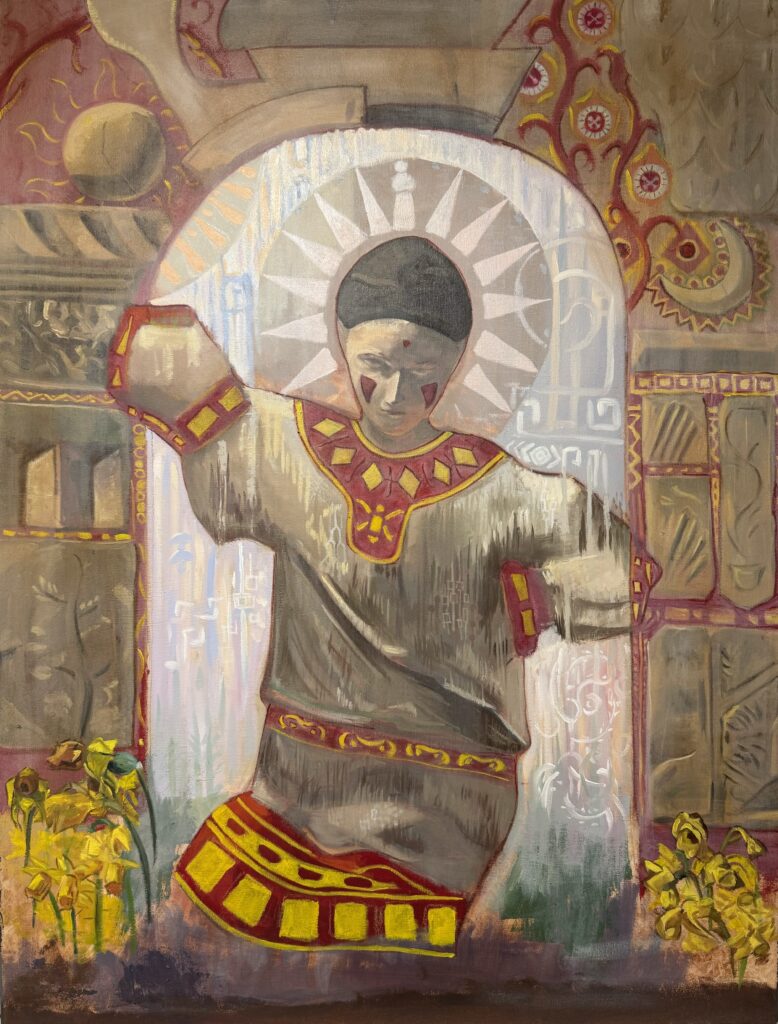
I’m doing this one a bit differently. It’s more of a voice piece than something I sat down and wrote.
A gallery director I know once said she was under no obligation to explain her own work, and that no artist should be. That idea is everywhere right now. The magic is in the mystery. I get why people say it. But when it came to my own painting, as soon as it was my turn to be picked apart, I wanted to say, no, that’s not really what this is about. And also, honestly, yes, you got it exactly right.
There’s an appetite out there to understand a piece as more than just what’s on the surface. I don’t want to hand someone a fixed meaning, because I think people should get to find their own. But I do think giving someone the process behind a piece lets them see it more clearly. Still through their own eyes. Just with more to work with.
So I don’t think explaining a painting is a bad thing. Some people treat silence as more serious, like saying nothing proves you care more about the work. But it can feel like the opposite too. Like you don’t actually care how someone else experiences it. A bit like going to see a school counsellor. Of course they cared about you, but you always sensed they cared more that you weren’t going to hurt yourself than about how you actually felt. Maybe that’s what it’s like for a viewer sometimes, like their read on a piece gets treated as beside the point.
So I’m not going to explain the painting exactly. But I do want to tell the story that sits next to it. Take it or leave it. It works with or without the story.
It starts after I left university. Uni was a hard stretch for me. I was studying engineering, not able to paint as much as I wanted, and not making any real dent on the art scene. I got into a few small galleries, sold a bit, but it was all so small scale. I’d get an idea, and by the time I actually got round to it, the idea had gone cold on me. That was frustrating, on top of everything else going on in my life at the time.
There was another thing in my final year. I got rejected from an art scholarship, one aimed at people who hadn’t studied art but still wanted to pursue it. I thought it was perfect for me. I only went for it in my final year, which I still regret, because by the time I actually applied, the competition was so intense I didn’t get it. None of the people who did get it were visual artists. A lot of them were dancers.
That frustrated me, but it also got me thinking. Who was actually going to appreciate what I do. I’ve never been someone who looks down on dance as a lesser form of expression, not at all. What did bother me was that visual art didn’t seem to be on their radar as a category at all. Maybe their facilities for visual art were already stretched, maybe they just weren’t taking more people in that space. But it still felt pointed. It got me wondering if visual art is a dying form. People have said that for years, though, so who knows.
I try not to sit in that kind of self pity for long. So I turned it into something. I was pissed off they didn’t choose me, if I’m honest, and in a fairly petty way I thought, right, I’ll paint a dancer. That’s how I landed on The Rite of Spring. It felt right anyway, because it represents a changing moment in art history. There was a riot at the premiere, and I always liked that. Maybe I felt like I half deserved my own version of a backlash, stepping backwards into that 1920s metaphysical, surreal world I’d studied at A level.
In the ballet, the dancer sacrifices herself. I don’t fully know what my own sacrifice was meant to be. Part of me wonders if I even made one. I didn’t give up my art for a career, not really. I socialised more at university than I do now, for various reasons, but I’m not sure that counts as sacrifice either. That’s probably just more self pity again. I don’t think I can really put myself in her shoes. But I did want to feel some kind of triumph over defeat, over that rejection, and that’s what I was chasing in the face of the figure I painted.
For the process, I’d wanted to paint this for a couple of years in different forms. I’ve always wanted to work from a live model, do proper studies, all of that. After graduating I went away on a trip, and like most trips abroad do to an artist, I came back overflowing with ideas. I couldn’t face going another year without actually making this piece.
So I had an idea. I’d done something similar before, painting statues I’d found and photographed. This time I didn’t even go to an antique shop. I 3D printed a head instead, sanded it smooth, and painted it myself. That became my model. I set up the lighting properly and everything. It genuinely helped me make the piece. It felt authentic, ingenious even. Though really, I was only solving a problem I’d created for myself, so I can’t take too much credit.
While I was away, I also went to Croatia, and near Split we came across the ruins of Salona by accident. We weren’t really planning anything on that trip. We’d just drive in a direction, not knowing where we’d sleep, find a beach, find the nearest restaurant. It was sunny, we’d just been for a swim, and then these ruins appeared. What struck me was how much had just been left there, preserved in place. Coming from the UK, where every Roman find gets lifted out and put behind glass in a museum, it was strange to see an archaeologist’s house built right next to the site, using stone straight from the old fortress.
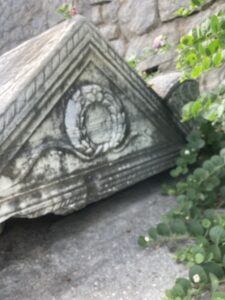
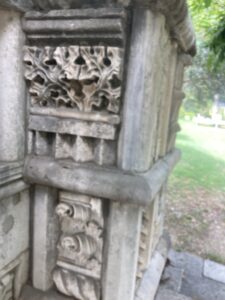
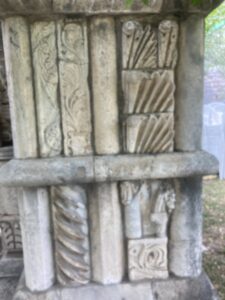
The ruins of Salona, near Split
We sat on old columns. Someone had made a garden out of the ruins. It felt like another version of the same idea, making something beautiful out of things that already carried history and weight. Not just nostalgia for the past, but the pull that history still has on us now.
So I brought that into the painting. I modelled a lot of it in clay, hair drying clay, then painted it. I went bright, almost too bright, which could easily have been a mistake. But it was also a nod to how ancient columns and statues were originally painted in colour, the way certain archaeologists reconstructed that from paint residue. For a long time I found that idea a bit horrifying, if I’m honest, colouring in the past like that. Now I appreciate it more. It treats history as something still moving and changing, not something you put on a shelf behind glass. Things repeat, they rhyme, and that relationship with the past isn’t always nostalgic in the same way each time.
I wanted the piece full of ornament too. Symbols, pattern, all of it. Some of that came from things I noticed in mainland Europe on that trip.
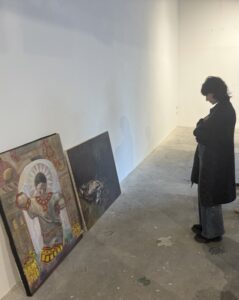
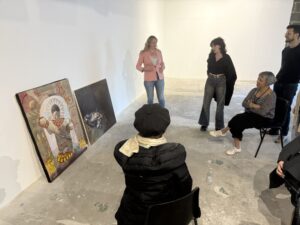
Critique with Bryony Hillman at the Bomb Factory
At the critique, people pointed a lot of this out, and I found myself agreeing or disagreeing based on what actually felt true to me, not just because someone with authority had said it. That back and forth is its own kind of relationship between the artist and the viewer. People sometimes say religious art is a mirror. Contemporary art too, in its own way. I think art should work more like two way glass. You look through it into the past and into the future at once, and the middle of that, right in front of the piece, is your own moment.
People were complimentary about the work. The main note I kept getting was about the flatness of it, almost a video game look, which is fair, because of how I built the surface. That’s something I want to work on, the push and pull between foreground and background. My old teacher used to say, paint the purpose, not always, but if a mistake creeps in that you actually like, keep it. I think that’s true here. This piece feels like it has a mind of its own.
People who’ve seen it have taken their own things away from it, and honestly, that’s fine by me. It’s not really about past and future for them the way it is for me. It’s just sitting there. A few people have shown interest, but most galleries haven’t wanted to take it on, because it sits in a strange no man’s land, somewhere between realism and that flatter, almost rendered look.
I used to paint with a lot of impasto, quite dark in value, because that’s what university trained into me. I wore a lot of dark clothes back then too, if that means anything. Like the columns at Salona, I decided to bring more colour and boldness into my palette here. Partly because I want to be known as a bold painter. It might look like it lacks depth at first glance, but there’s definitely structure underneath it.
I should probably go back to my room and actually finish this painting, it’s taken me long enough already. But I do want to say, the critique I got at the Bomb Factory was genuinely useful, and I owe some of that to Bryony Hillman, who ran it and whose own work is worth looking at.
The finished piece is available to view here: The Rite of Spring, or browse more of my personal work in the Portfolio.
Read more from the studio:
George Baker and His Dad · Why I Still Paint Commissions · On Pet Portraits